Spotsolas na Míosa - Sadhbh Nic Dhomhnaill
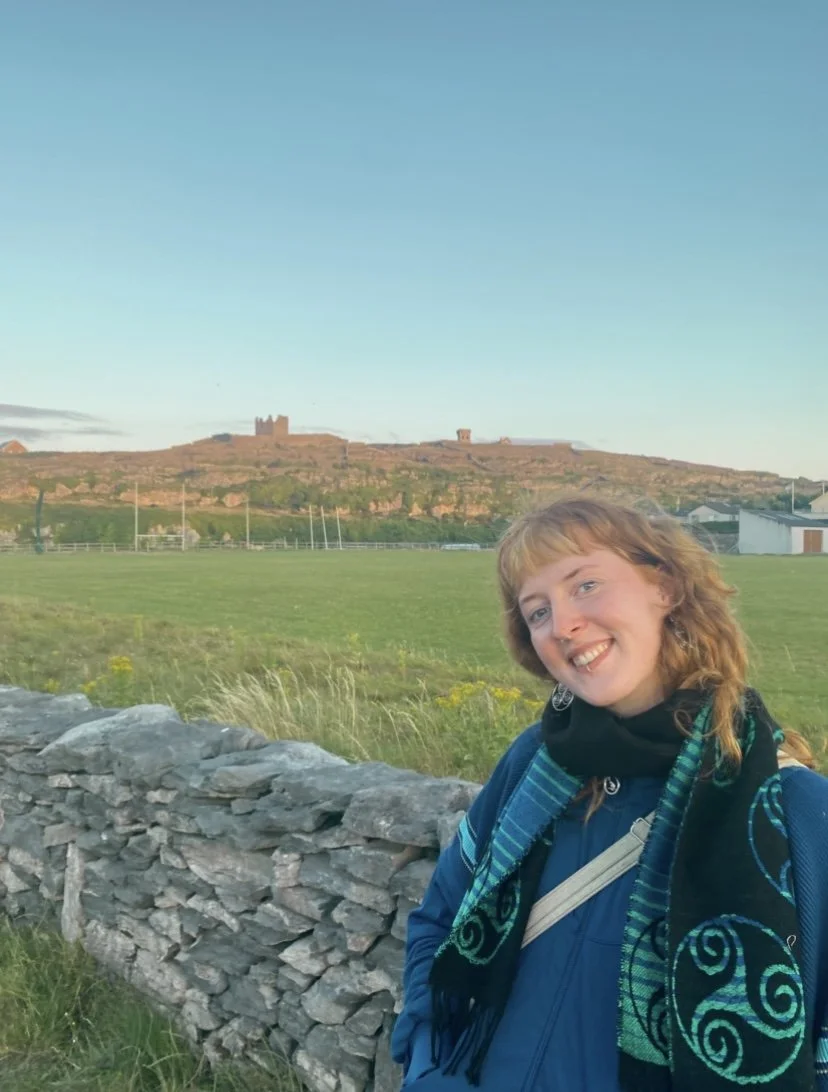
This month, we’ll be getting to know Sadhbh Nic Dhomhnaill from Dublin, who recently started a traineeship as a translator in the European Parliament. Read about her experience in the Irish language, her interest in the language, and life in Luxembourg with the European Parliament.
Tell us about yourself, where are you from and where did you learn your Irish?
I’m from North Dublin. As for my Irish, I didn’t speak it at home and I didn’t go to a Gaelscoil, but while I was in school, I was lucky enough to go to the Gaeltacht at Coláiste Chamus in Connemara a few times, where I discovered my love for the language and my Irish improved loads.
You did an undergraduate degree in New-Irish and Sociology – what did you like about it?
I really enjoyed the degree. It was great to meet people who were as passionate about Irish as I was. There was a different outlook on Irish back then, before it became as “cool” as it is today. I had a sociology minor, so it was nice to have some variety, but Irish is really what I was focused on.
You had various jobs in Irish until now, tell us a bit about them.
I did! The first job I had with Irish was as a caretaker with Conradh na Gaeilge on Harcourt Street. I had to make tea and coffee for the learners at break times - the most relaxing job I've ever had! Then I worked at Club Conradh na Gaeilge in Dublin and Club Áras na nGael in Galway, two jobs I really enjoyed. I taught Irish to adults and I worked in subtitling, and now I'm a translator!
Last month you started out on a training scheme as a translator in the European Parliament in Luxembourg – congratulations! Tell us about it.
Thank you! To tell the truth, it’s crazy that I’m here. I didn’t think this life was in store for me, but as the competition came up, I thought I’d apply and see, and I’m so glad I did. I wanted to move abroad but I didn’t want to leave my Irish behind. With this job, it’s an opportunity to be abroad and nurture my Irish at the same time! It’s brilliant.
To enter the competition for this training scheme, what are the skills and qualifications that you needed?
The thing that was most needed was a high standard of Irish. It helps if you have experience or a qualification in translation, but overall the quality of your Irish is the most important thing.
You worked as a subtitler with Telegael. Are there many similarities / differences between that and being a translator?
There certainly is! Subtitling involved a lot of translation, but it was a different style. There were a lot of rules regarding reading speed, subtitle length, number of characters, etc. It was quite restrictive in a way, so I had to be resourceful to meet those requirements, which I liked. But with the legislative translation that I do in Parliament, it doesn’t matter how long the sentence is; the wording is what matters. So while translation is involved with both of them, they require very different approaches.
In addition to your expertise in Irish, what tools do you use when translating?
There are plenty of tools that we use to make our lives as translators easier. The biggest thing is the translation memories that are stored in various databases. Translation memories mean that every sentence translated is entered into a database, and if you need to translate the same sentence, it will automatically come up. I also use the dictionaries and online sources, Teanglann, Foclóir, Téarma, IATÍ, Corpus, an Gramadóir, and of course the Caighdeán Oifigiúil.
In your opinion what are the skills that are important for this role?
In my opinion, the most important skill for this role is that you have a sharp eye. Everything has to be very exact, so you need to be proficient in your writing and be very attentive as you proofread.
Did you have any challenges in your first couple of weeks?
I suppose the challenges I had at the start was understanding the structure of the Union and the way everything works here. With regard to the work itself, it took me a while to understand the different styles and conventions, but altogether the change was very easy. There’s about 100 other trainees so there’s no shortage of good fun here and it was pretty easy to get to know people.
Do you use AI and do you see that there is a change with translation in the EU because of it?
I don’t use AI myself and I’m not the slightest bit interested in it either, however it’s definitely a topic of conversation in the Union. It’s a concern for translators that AI will steal our jobs, but they say people will still be needed to proof the work of Artificial Intelligence. I’d prefer it came to an end, to me it seems it does more harm than anything else.
Do you have any other language or is it on your mind to learn another language? Is it necessary to have another language as you’re working in the Parliament?
I have a B1 level of German and I’m improving it as I’m here, as well as my French. For this traineeship, I only needed two languages – Irish and English. To get a permanent position as a translator, you need at least three languages. However with the third language, you only need to have a B2 level.
Does Irish have a strong status in Luxembourg in the workplace and socially?
Irish can be seen around the Parliament, especially as Ireland is currently undertaking the Presidency of the Council. Also, myself and the other Irish trainees are organising Irish classes and there is a lot of demand for them – there’s around 15 people in the class! There are no Pop-up Gaeltachts in Luxembourg unfortunately, but there are trad sessions every month and a lot of Irish go to them.
Do you have any advice for people that want a career as a translator in the EU?
Do it! It is a brilliant job and there is a lot of demand for translators with Irish. There’s plenty of jobs without much competition so there’s a good chance you’ll find something. It’s a fantastic opportunity to move abroad and improve your Irish. I highly recommend it!
Tell us about life in Luxembourg, what do you like about it? Would you recommend it?
I’m very happy here in Luxembourg, she’s an adorable little city. Before I came here, I heard there wasn’t much happening, but that’s not true at all. There’s a great deal going on and plenty to do. Unfortunately the cost of living is very high, but to tell you the truth Ireland isn’t too far behind! At least the public transport system is free so you can go wherever you want without spending a penny. And if you want to go outside the country, Paris, Brussels and Cologne are close by, it’s very handy altogether.
And finally, what is the grammar rule that surprises you still?
The grammar rule that still surprises me is the relative clause. It has been tormenting me for years but I pretty much have it now! Still though everytime I have to write it, I doubt myself. There’s a chance I have it wrong somewhere in these answers, but if it is don’t say a thing!