Spotsolas na Míosa - Siobhain Grogan
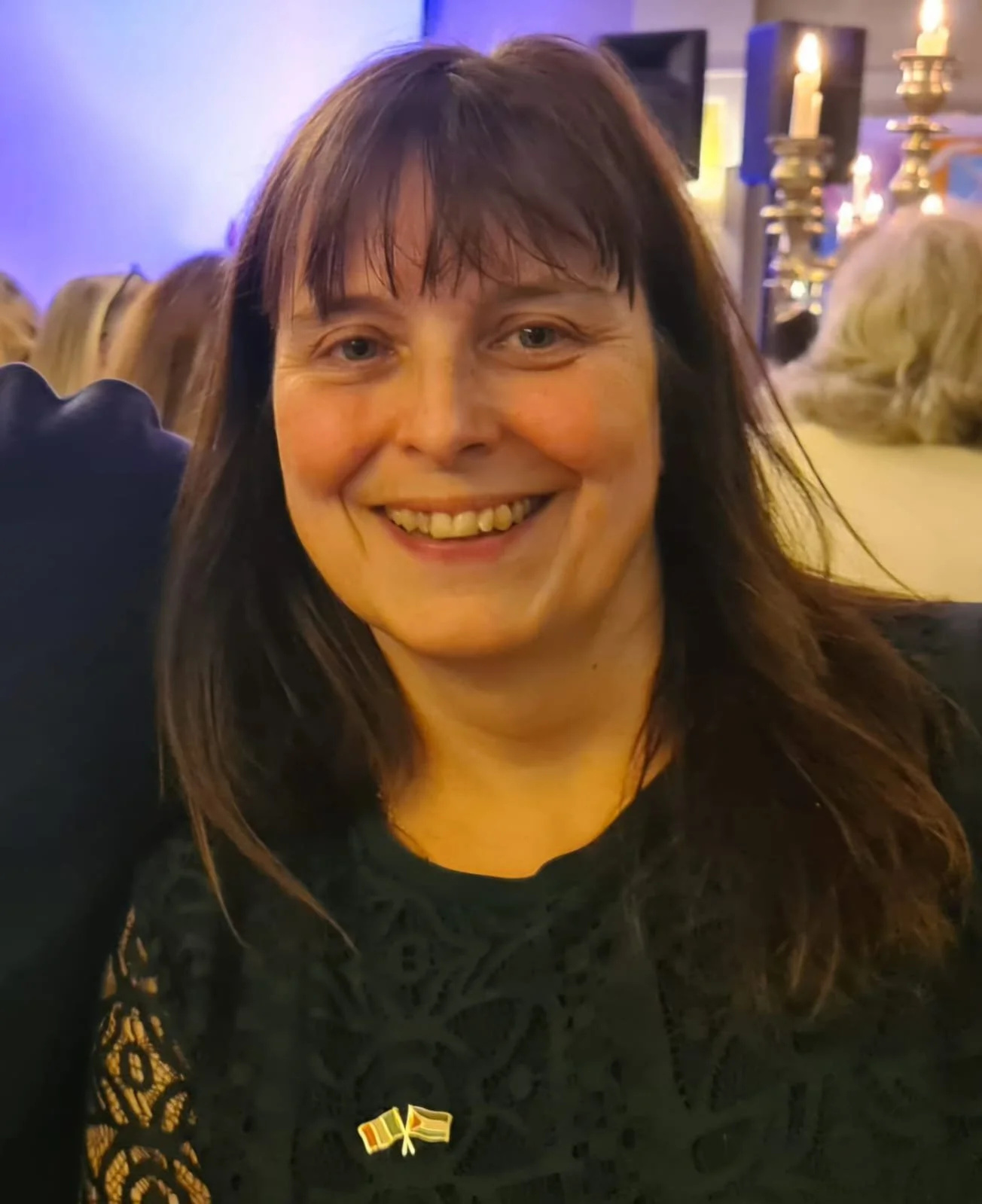
Blurb ag teastáil
Where are you from?
I was raised in Naas and I still live there.
Did you grow up with the Irish language?
No, I did not. I was brought up speaking only English, I went to all-English schools, and Irish was not a part of my life outside of school at all while I was growing up.
What sparked your interest in Irish?
I went to Coláiste Chamuis at the end of 5th year. That was the first time I had the chance to speak and hear Irish as an everyday language. That was when I truly realized that Irish is a living language and that I would want to speak it.
Then I came back to the language as an adult. I was lucky that a friend of mine was interested in traveling on the same journey. Two heads are better than one! After a while, I started going out with that friend, and we got married! We wouldn't be together without the Irish language!
What difficulties did you have when you decided to raise your children through Irish?
Because my husband and I were raised through English, we didn’t have the vocabulary for parenting ourselves. At that time, we didn’t know anyone locally who was going on the same journey. We were swimming against the current and figuring it out ourselves. Resources like Gaschaint helped us a lot.
Things got easier when we met other families in the area who spoke Irish at home. We went to family week in Ballyferret with Comhluadar, then Glór na nGael, and we met other families from all over the country there.
You spent many years teaching in an all-English school. Why did you move to Gaelcholáiste Chill Dara (GCCD)?
I was ready for a new challenge. Sometimes teachers get very comfortable in a school and don't want to move to another school for fear they wouldn't be as happy there. But a change of work environment is a good bet!
Because there is a specific vocabulary related to school subjects, which I didn't have, I didn't think I would be able to teach in an all-Irish school. A few people told me I wouldn't have a problem learning the terms and that I would pick them up quickly while I was there. They were right. It's a pity I didn't realize that years ago!
Also, I strongly believe that it is a fundamental right for children to receive a high-quality education through Irish. There are challenges in finding teachers who have Irish and the necessary subject knowledge. I had the opportunity to do my part regarding that effort.
What challenges did you face when you started teaching through Irish?
Because I had no experience learning or teaching math through Irish, I had to learn all the terms. I put a lot of effort into it when I started. It was easier than I expected. During my first year at GCCD, Covid happened, and there were bigger challenges involved with that!
What are the benefits of working through the medium of Irish?
It’s something really special to be among young people speaking Irish. Not everyone gets that opportunity, and I would recommend it to any teacher who’s interested in Irish. It quickly became clear to me that I wouldn’t be happy working in an all-English school again.
It’s important that there is a connection between Gaelscoileanna and the Irish-speaking community in general. It’s crucial that there are opportunities for students and former students to use their Irish outside the school walls. Because of my own connection (and that of others) to both sides of those walls through my work with Cill Dara le Gaeilge, it’s easier to bring them together.
What are the benefits of working through the medium of Irish
It’s something really special to be among young people speaking Irish. Not everyone gets that opportunity, and I would recommend it to any teacher who’s interested in Irish. It quickly became clear to me that I wouldn’t be happy working in an all-English school again.
It’s important that there is a connection between Gaelscoileanna and the Irish-speaking community in general. It’s crucial that there are opportunities for students and former students to use their Irish outside the school walls. Because of my own connection (and that of others) to both sides of those walls through my work with Cill Dara le Gaeilge, it’s easier to bring them together.
How did you encourage the students to use Irish outside the classroom?
This is a huge challenge. I set up a module for intermediate students called 'The Importance of Irish'. The students know Irish, but often they don’t understand why it’s important. This module gives them a space to discuss these questions and gain a deeper understanding of it.
The most effective way to get young adults involved in the world of Irish outside of school is to give them leadership roles. Students and graduates of Gaelcholáiste Chill Dara are ready and willing to help with local events – for example, the Féile Sráide Nás na Ríogh (Naas Street Festival) on St. Patrick’s Day and Lá Teaghlaigh (Family Day) in June. It would be impossible to run festivals like these without the support of those young people.
One of Cill Dara le Gaeilge’s goals is to set up a cultural center for Kildare. Young people and the wider Irish-speaking community really deserve a local center like that. It would be a real game changer for the language in the area. I promised the students that we're working on it.
Is Irish visible/audible when you're doing your shopping on the weekend, for example?
Yes, but not as often as I would like. When I say 'thank you', sometimes someone responds with a few words. There are students and GCCD graduates working in quite a few of the shops, pubs, and restaurants in the area, and that's great because I can do everything in Irish there.
There's a business scheme in Kildare called Gnó Chill Dara, and it's growing. Sometimes, businesspeople worry if they aren’t fluent in Irish, but people are welcomed into the scheme even if they only know a little Irish, as long as they're willing to use that a bit.
What challenges do you see for the Irish learner?
The biggest challenge for Irish people is probably a lack of confidence. Sometimes, frustration is mixed with embarrassment and disappointment. When people give themselves a 'fresh start,' it becomes much easier for them. Newcomers to the country don't carry the same 'baggage,' but sometimes when they go to 'beginners' classes, there are Irish people there who have done 14 years of Irish at school! Classes at different levels are needed.
Then, they need to get speaking opportunities to give them a chance to see improvement. That gives people encouragement.
What advice would you give to someone thinking about learning Irish for the first time?
Do it! What are you waiting for? There's a welcoming and fun community, get involved. Find a conversation circle or Pop-up Gaeltacht in your area and go regularly. If there isn’t one near you, find one online and, after a while, start one in your own area.
If you’re going to tackle it more seriously, in addition to building speaking opportunities, listen to a bit of Irish every day, read a bit of Irish every day, write a bit of Irish every day. There are excellent resources now for adult learners, be sure to make use of them.
You are the Chairperson of Cill Dara le Gaeilge. Why did the committee decide to set up the organization?
There was a small group of us with the same goal – to create opportunities to use our Irish in every area of our lives. We continued as the Irish committee as part of the community group, Sult na Sollán, but we wanted to hire people to achieve our plans. Cill Dara le Gaeilge was set up as a non-profit organization in 2017, and we gained charitable status in 2026.
With the volunteer workers and the staff employed by CDleG, we can do much more than we could when we were relying on volunteers alone.
Tell me about some of the achievements of Cill Dara le Gaeilge.
As I mentioned, I grew up in Naas and I didn’t hear any Irish in the area when I was young. Now, it would be unusual for me to walk through the town without hearing 'Dia duit' heading my way. I’m not saying that Cill Dara le Gaeilge did everything, but we’ve introduced people to each other through various events over the years. It also helps a lot that there’s a Gaelscoil and Gaelcholáiste located in the town, of course.
Kildare is the only county in Ireland that has a language plan for the entire county. That’s an achievement, and it has really helped us put structure on our ideas and goals. The second plan covers the period 2024 - 2030.
Along with the Gnó Chill Dara, we have a support scheme for families, Teaghlaigh Chill Dara. We have other groups that focus on specific things, like a book club, Coiscéim Cill Dara (walking club).
Over the past few years, we’ve been putting special emphasis on people who are new to the country and developing that work. Teanga do chách (Language for Everyone) is the name of that initiative. It gives opportunities for newcomers to get a taste of Irish and Irish culture through different languages, not just English. It gives people who already speak Irish a chance to experience new languages through Irish. Language exchange, cultural exchange, and taste exchange.
We won a Good Cause Award at the National Lottery two years ago and were very proud of the recognition it gave us. The judges mentioned that we were inclusive as an organization and it really touched my heart.
What resources does Cill Dara le Gaeilge provide?
Our best resource, without a doubt, is the community around us. We are spoiled with a vibrant, motivated, inspiring, and welcoming community. You can't put a price on that kind of resource. It takes years to create and develop it.
We provide events for all age groups and all levels of Irish so that it's clear there is a space for everyone in the world of Irish.
There’s a shared calendar for the county on the website www.cilldaralegaeilge.ie, and community groups working for Irish from every barony in the county have access to it.
We have a scheme focused on families, Teaghlaigh Chill Dara. That helps people who want to use more Irish at home. In addition to classes for parents, there are regular workshops, a parent and child group, and a weekly fun club.
We have a scheme focused on businesses, Gnó Chill Dara. It helps people in business who want to offer services, marketing, or signage in Irish. A new brochure for the business scheme will be launched soon.
It's hard to mention everything, but if you want more information or to take part in Kildare's language revolution, get in touch with us. All information is available at www.cilldaralegaeilge.ie