Spotsolas na Míosa - Máire Seó Breathnach
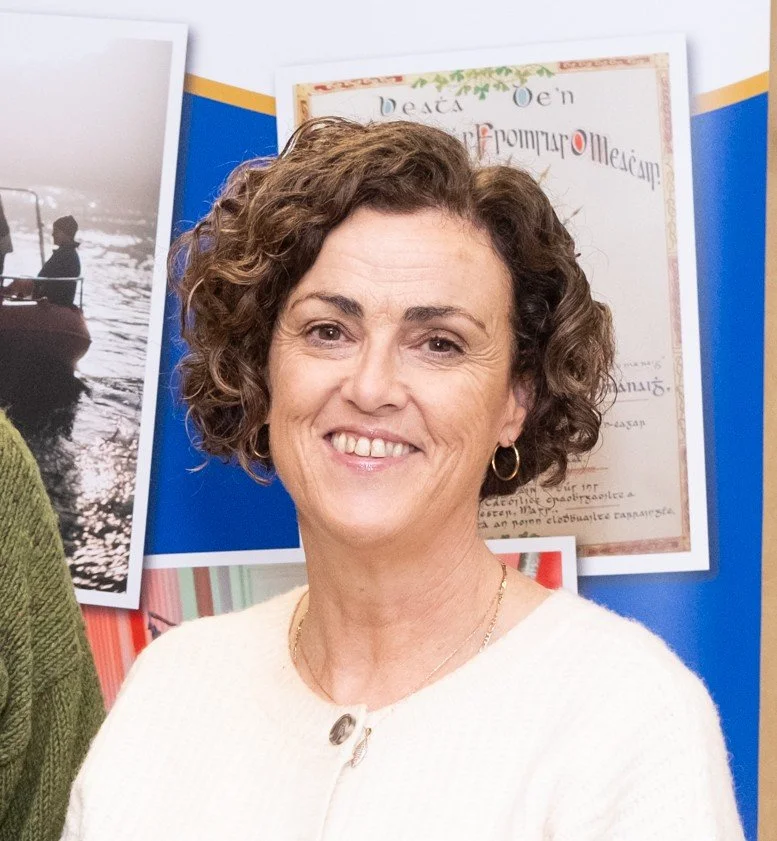
This month we spoke with Máire Seó Breathnach - a woman from An Seanphobal in Gaeltacht na nDéise, Co Waterford and she works as an Irish Language Development Officer with Waterford City & County Council. She has also sat on committees that have been promoting the Irish language for many years.
Where did you learn your Irish, did you have it growing up?
I’m a native Irish speaker. I learnt Irish at home and at Scoil Náisiúnta Bhaile Mhic Airt in An Seanphobal.
What do you find most exciting about working through Irish every day?
Irish is an integral part of my personality and is very important to me. The most exciting aspect of the work is working with the people on the ground in the Gaeltacht and Dungarvan, a Gaeltacht Service Town. It is also exciting when I meet individuals across the county who are working to preserve and promote the language and culture, whether it be through speaking it, at events or organising events.
What is the biggest challenge you see in promoting the Irish language in the context of your work as an Irish Language Officer in Waterford City & County Council?
Offering the Council’s services through Irish to the same standard as the services offered through English is one of the greatest challenges, there is a lack of proficient Irish speaking workers and an absence of any realistic national strategy to achieve this.
Since I started working in this post over a decade ago, despite the language legislation, I have seen a reduction and depletion in the number of Irish speaking employees working in the public service and the ability of the public sector to provide services through Irish.
Many schemes to encourage the use and learning of Irish were discontinued – I'm referring in particular to the loss of Gaeleagrais (which gave scholarships to go to the Gaeltacht to learn the language) and the option for people applying for a job in the state system to be interviewed through Irish to obtain additional points – be it for the Library panel or the Clerical Officers panel in the case of local authorities, for example. No such strategy or tools have been put in place to attract people with Irish, or to encourage people to learn Irish or to improve their language abilities.
Are there particular problems when people want to use their Irish in the public service, and how do you support them?
It is an integral part of my job to support the provision of Irish language services to the community, either by supporting the various Council Departments to provide services or by supporting members of the public who are seeking such services. Of course, the provision of Irish language services depends on resources, both human and time/financial, and the biggest barrier to the widespread provision of Irish language services is that only a very small number of people with high Irish language ability are employed in the Civil Service at present.
A certain amount can be done in terms of providing information, forms, and printed materials in Irish, but providing a spoken service through Irish is something else altogether. Currently, this depends entirely on people with Irish being employed in specific departments within the organisation, and more often than not there isn't a competent Irish speaker to deal with the customer through Irish.
While I am acting alone as an Irish Language Officer serving the whole organisation, I do my best to help departments find an external translation service, translate certain documents myself, or point a member of the public towards the appropriate people to receive the service through Irish, where it exists.
I also act as an the middlewoman for An Coimisinéir Teanga and other organisations such as Údarás na Gaeltachta, Foras na Gaeilge, Conradh na Gaeilge etc.
From a staff perspective, non-native speakers or fluent speakers are hesitant to use their Irish, as they lack confidence in their language abilities. This becomes even more difficult if there are technical or complex matters to discuss with the customer. This is another challenge that needs to be addressed if the provision of services through Irish in the public sector is to be improved.
Tell us what Comhlucht Forbartha na nDéise does.
Comhlucht Forbartha na nDéise CTR is the community and language development body for Gaeltacht na nDéise. It was established in 2005 to promote community and language development in An Rinn and An Seanphobal as one Gaeltacht area. It was appointed a lead language planning organisation for Gaeltacht Irish Language Planning Areas in 2014 and has since worked to support the continuation and strengthening of Irish in Gaeltacht na nDéise, as well as supporting the development of resources and services in the area.
I have been Waterford City & County Council representative on the Board of the Comhlucht since it began, acting as Secretary to the Board. I work closely with the Board and the executives of the Comhlucht in the interests of the language, community and social development of the Gaeltacht.
Where do you see the future of the Irish language in the next 20 years — what will that look like?
Despite the ups and downs relating to the position of Irish Language Officer, I would be hopeful for the future of the Irish language overall. I meet and work with people who are passionate about the use and promotion of Irish language. They have a strong Irish identity and do their best day to day.
I feel that there has been a particular upsurge and growth in the Irish language in recent years. I find that the impact of Irish-medium education is now visible to the general public and people are showing more respect and interest in the language and culture. When you see the success of bands such as Kneecap, Amble, along with the booming traditional music scene; the rise in Irish language film and TV - An Cailín Ciúin, for example; and the growth of Irish on social media, there's a lot to be hopeful about.
A minority language will always be struggling against the tide, but if we are to keep the Irish language alive and to pass her on from one generation to the next, it must come from ourselves as individuals and as a community – from the bottom up.
You have been an Irish Language Development Officer with Waterford Council since 2002, how do you see the role of Irish changing among young people, inside and outside the Gaeltacht?
To be 100% honest, it's not the young people who attend the sort of events I generally organise in the community! That said, I see the growth and development of the language among the younger generation through my children and other talented young people that I work with, such as the Language Planning Officers here in na Déise (Gaeltacht and Dungarvan). Two capable, talented young women, who are language learners, who respect and love the language while using their skills and talents for the promotion of the Irish language and Irish language culture on a daily basis. I commend them.
In addition, my own daughter was involved in Cuallacht na Gaeilge in UCC working with energetic, courageous young people with Irish as their language of communication. I see her and her friends working for the language throughout their careers. You only have to look at the surge in Irish on social media and in the digital sphere to see the results of their work. It gives me hope for the future.
Earlier this year you were presented with a lifetime achievement award by Comhlucht Forbartha na nDéise and Dún Garbhán le Gaeilge, a recognition of all the work you have done to preserve and promote the Irish language in County Waterford. What project or moment are you most proud of?
There were many different things that I done (and am currently doing) that I was proud of back through the years. Whenever I work in the community, it gives me courage and hope. I organised Tionól na nDéise in various communities throughout Waterford for many years, and I have always been inspired to join local communities and organise Irish language and cultural events alongside them. One of the highlights of those years was the night in 2006 when Dara Ó Cinnéide and Seán Óg Ó Alalpín came to Dungarvan for a special event in the Council Chamber, in which we celebrated the fine speeches they gave as Gaeilge on Hogan Stand in Croke Park. That was a very special night.
I was particularly proud of my time as the Gaeltacht representative on the Bord of Údarás na Gaeltachta from 2017 to 2019. It was a privilege to be able to work on behalf of this Gaeltacht community and bring the voice of the small Gaeltachtachtaí to the table.
Another event that I can recall is Cuisle Ceoil, a very special concert that I organised last year where I have been living for 25 years now, Ardmore in west Waterford. It was a celebration of the establishment of Coláiste Gaeilge Deuglán 100 years earlier, with three choirs - Cór Fear na nDéise, the local Community Choir and children from Scoil Náisiúnta na hAirde Móire. It was a special night and I was very proud that night when we presented the Irish language and the Irish culture of the parish in St. Paul's Protestant Church.
Tell us about, and the importance of, the placenames project established by Waterford County Council for the national schools in the county?
I established the Waterford Council Placenames Committee 22 years ago to preserve and promote the placenames of na Déise. The volunteer members of this Committee have been ploughing on for many years and I am proud of how the Committee has grown and developed over the years. The Committee's maintask is to approve suitable names for housing estates across the city and county of Waterford, but we also organise other projects to preserve and promote the placenames in na Déise, one of which is the Schools Placenames Project, which has been running since 2012.
Through the project, we work with children from different national schools to help them research local place names – field names and so on. They have to go out and look for the names, find the stories behind the names and record them on an interactive online map. It's a great way to encourage children's interest in their local history and heritage and it's great to see the impact the project has on them. We have completed this project in 26 different schools over the last 13 years and it is of considerable importance in terms of the preservation of local placenames' history and heritage.
How do you relax after a day's work?
I like walking and yoga and a little running, as well as watching a good TV series on Netflix! But what I find most rewarding is relaxing with my family at home or on holiday.
What is your favorite word or phrase?
nuair a bhíonn an cat amuigh bíonn an luch ag rince - when the cat is away the mice will play