Spotsolas na Míosa - Joe Simpson
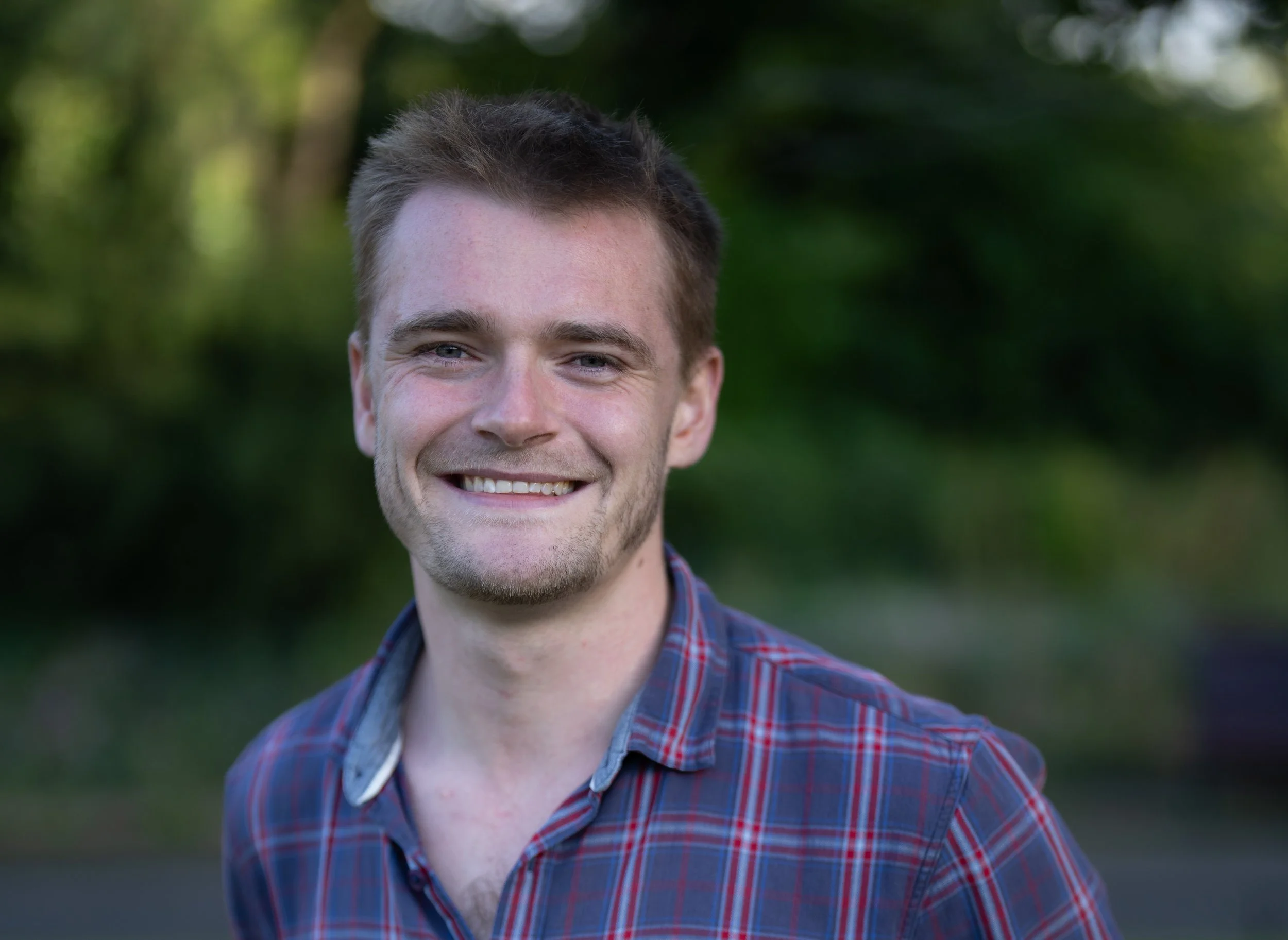
This month we spoke with Joe Simpson. Joe is a researcher from the UK with an interest in Celtic languages. Read more to find out how he learned Irish, what his research entails and lots more!
You achieved a BA in modern and medieval languages. What got you interested in languages?
Luckily my parents had a keen interest in languages when I was growing up. My stepmom has Spanish, and my mum has Greek - I remember her helping me read the Greek alphabet on the side of a Coco Pops box when I was quite young - I loved the shape of the letters and how much can be said within one word. I have always been very interested in grammar - I feel that there is beauty in how the different aspects of the language go together like a jigsaw.
You were born in England. What attracted you to Ireland?
My main undergraduate subjects were Spanish and Arabic and I always thought I would land in South America or the Middle East. However, in the years after graduation I became very interested in the history, languages and politics of Britain and Ireland. I decided to pursue a master's degree in Scottish Gaelic at the University of Edinburgh, where I became interested in language policy and planning. It's the same interest that directs my career path today.
As part of the master's course, I did modules in Old Irish and fell in love with it. I was impressed with how complex the language was and how much the Irish language has changed over the years. I applied for a PhD scholarship in the field of Old Irish at UCD – I never thought I would be accepted, but I was and started the course in September 2020. I successfully moved over from Scotland a year later and have been living in Dublin ever since.
How did you learn your Irish?
I started learning Irish in 2020 when I heard about the PhD. It was definitely an advantage to have Gaelic already, but I often mix them up and now I have very little Gaelic left!
I got my Irish from two friends of mine who have a lot of teaching experience and both have excellent Irish. I would do face-to-face classes with one of them and meet the other person for a few hours per week on Zoom during lockdown to practise what I had learnt that week and to learn a lot more too!
When I moved to Ireland, it was mainly in Club Chonradh na Gaeilge that I used my Irish. It was mainly through Irish that I spoke to my friends, so I learned quickly!
What do you find most interesting about Celtic Studies?
Celtic Studies is a very complex study. I have only studied a small part of it myself. That would be one of the things I like about the field – that it has so much variety. Celtic Studies encompasses a multitude of different subjects within the fields of literature, linguistics, archaeology, art and history, among others.
Celtic languages are, course, my main interest in Studies. The Celtic languages stand out from the other Indo-European languages in terms of initial changes and word order, for example. I am also very interested in the language campaigns through which the languages are being revived. The revival of the Welsh language, for example, was the most successful community campaign in Britain since the Suffragette movement in the early 20th century.
What is your favourite language? What is your favourite word or phrase?
I love Irish and am very happy to have a career where I work through Irish... However, there will always be a special place in my heart for the Welsh language. It was the first Celtic language I realised existed, and I have been learning it (periodically) since secondary school. The rhythm and sounds of the language are beautiful – just listen to a few songs of9Bach to understand what I mean. It would be hard to pick just one word, but here are a few I love: Llechi (slate), wy (egg), dychrynllyd (terrible), cyfaddefaf (adjective).
You are a researcher at Maynooth University, please tell us about your research.
The research was a major study entitled Ár gCampas, Ár dTeanga. I discussed and analysed the attitudes, ability and use of Irish among Maynooth University students and staff to provide an evidence base about language planning in the institution, in a way that is consistent with the aspirations of the whole University community. I made 25 recommendations based on the results of the research, which showed that there is goodwill among the University community towards the Irish language, but that it is not considered that institutional support is always matched by that goodwill. I was honoured that Catherine Connolly launched the research earlier this year and I hope to be able to continue with the same research in the future as my recommendations are implemented.
Which research methods do you use?
Ár gCampas, Ár dTeanga was all about ‘modhanna measctha’ or mixed-methods research. I also conducted focus groups and semi-structured interviews with over 60 people across and beyond the University to understand the wide range of perspectives people have towards the Irish language and what is needed to foster it.
Next, I collected quantitative data on capability and demand through two surveys (one for students and one for staff). It's apparent that the project sparked some interest, as approximately 46% of Maynooth staff completed the survey! I performed a basic statistical analysis of the quantitative data and a thematic analysis of the interviews. People can read all the findings in the research report. I am very grateful to all the participants who participated in the proposal and to everyone who helped me in compiling the report.
Tell us about GaelScéal, a campaign of Lárionad na Gaeilge, Maynooth University.
Gaelscéal is a series of portraits and personal stories such as Humans of New York. Gaelscéal arose from the Ár gCampas, Ár dTeanga project and gives an insight into some of the stories that Maynooth University students and staff have in relation to the Irish language. It reflects the broad range of experiences and perspectives, both positive and negative, that the University community has towards the language. Many thanks to Daniel Bălteanu who took the beautiful pictures for the series. Gaelscéal can be viewed here!
Could you give any advice to anyone interested in doing a piece of research?
The most important thing is to plan properly. You'll be very grateful! It is necessary to be realistic about the timeline and what you can achieve within that period - research proposals often increase exponentially. If you are organised and record each stage of the proposal correctly, you will do well!
What's your favorite fun fact?
A friend of mine is working with the Historical Dictionary of Modern Irish at the Royal Academy. He gave me the etymology of the word ‘plámás' a few weeks ago and I thought it was very cute. It comes from the French word blancmange –a type such as English ‘sweet talking’ or ’buttering up’, GRMA Emmet!
How do you relax after a day's work?
I have two methods – being very fit or rotting on the couch! I love running, going to the gym and most of all, being out on the bike – I've seen almost every county in Ireland from the saddle!
At the same time, I love playing computer games, watching movies with the housemates, or having a few pints in a nice beer garden. Is féidir an dá thrá a fhreastal!
What's the best advice you've received?
Don't be hard on yourself! I would often (and still do) struggle with siondróm an phasadóra or impostersyndrome during the PhD, in my work, and in academia in general. It's easier said than done, but it's important to try and be kind to yourself, if possible!